Heritage buildings are often some of the most valued properties on a street, and some of the hardest to repair well. Years of patch repairs, unsuitable materials and well-meant changes can hide the original fabric and create new problems, such as trapped moisture.
In October 2026 the NSW Government announced that Bonnyrigg House, a home completed in 1826 and listed on the State Heritage Register, will stay in public hands and be restored. The way that project is starting is a useful example for any owner of a heritage building: understand the building first, then repair it.
What has happened at Bonnyrigg House
According to the NSW Government’s 22 October 2026 release, heritage specialists are progressing conservation works to return the house closer to its original colonial form. The aim is to reverse unsympathetic alterations made over two centuries while meeting current building standards.
The early work has focused on protecting the building and learning about it. Trees have been pruned and vegetation managed to reduce fire, pest and storm risk. Invasive lantana and privet growing over the building have been removed, which has allowed archaeological and landscape investigations to take place before restoration begins.
On the same day, the Department of Planning, Housing and Infrastructure reported on a second project further along. At Cecil Hills Farm, also on the State Heritage Register, a $1.5 million restoration is being delivered in two stages. The first stage, on the homestead, covered roof, weatherboard and window repairs and repainting in colours matched to the original paint. The second stage, on the historic outbuildings, uses specialist heritage tradespeople and traditional techniques, including hand-split ironbark and soft lime mortar. Staging the work this way lets the most important building be secured first.
Beams & Dreams is not involved in either project. They are used here only as public examples.
What heritage conservation usually involves
Every building is different, but conservation projects tend to follow a similar order.
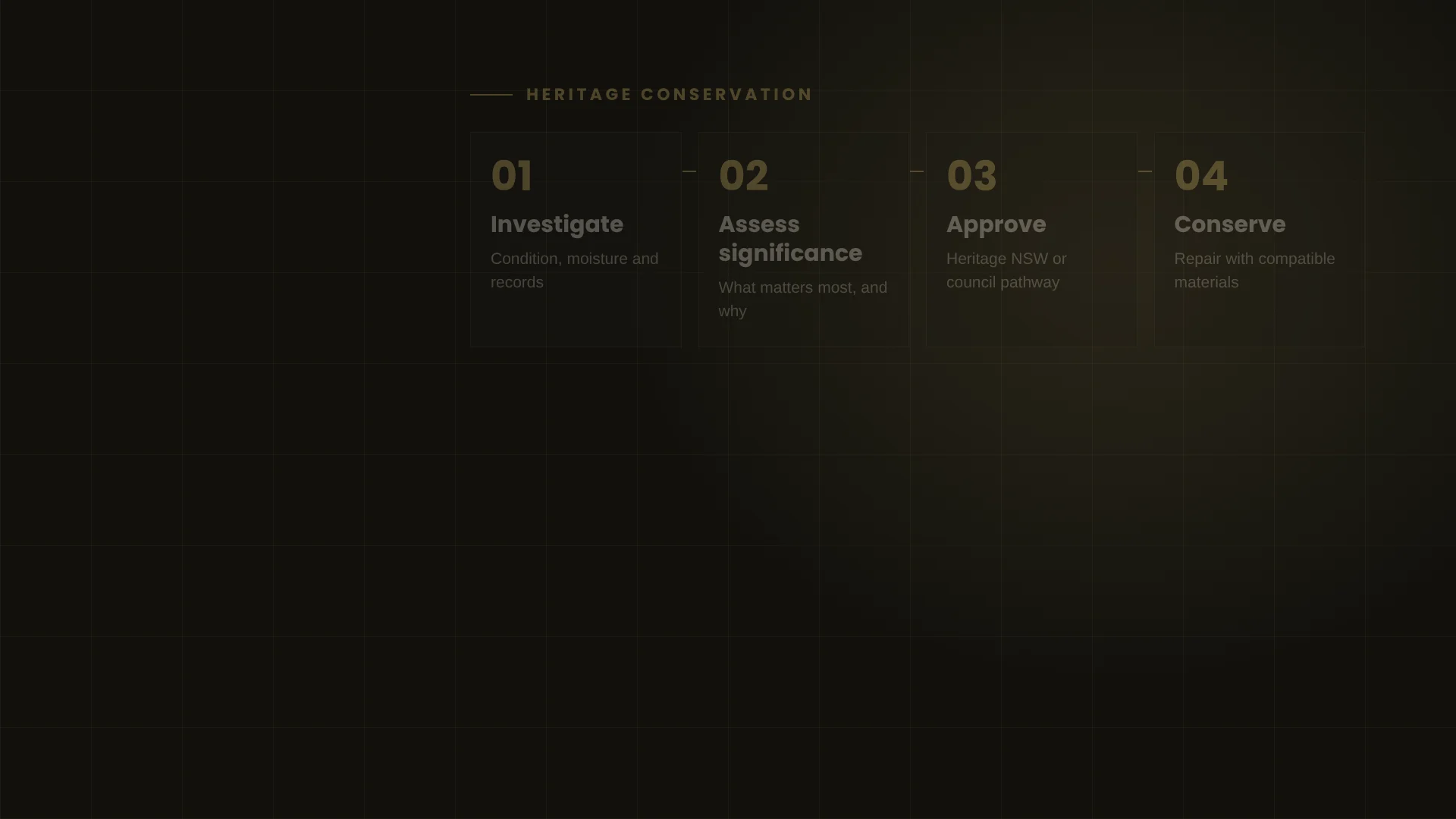
1. Investigate before you design. A condition survey, a moisture assessment and a review of historical records show what is original, what has been changed and why defects are happening. Opening up small areas may be needed to confirm what is behind later finishes.
2. Understand significance. A heritage professional identifies which parts of the building matter most. This shapes which elements are repaired, which are replaced like-for-like and which later changes could be removed.
3. Manage the surroundings. Vegetation, drainage and ground levels against walls often drive damp and decay. Dealing with these first can protect the building and reduce later repair costs.
4. Repair with compatible materials. Older masonry, mortars, renders and timbers often behave differently from modern products. Using materials that suit the original fabric reduces the risk of new damage.
5. Meet current standards where needed. Restoration can still need to address fire safety, structure, access and services. A heritage specialist and the certifier usually work together to find solutions that respect the building.
Which approvals can apply
The approval depends on how the building is listed.
For items on the State Heritage Register, Heritage NSW explains that a section 60 works application under the Heritage Act 1977 is needed for works with a moderate or greater impact on heritage significance, unless the works are covered by an exemption. A statement of heritage impact and existing and proposed drawings are among the required documents. Heritage NSW states an assessment timeframe of 40 days, or 60 days if the application is advertised, with the clock stopping while more information is requested.
Heritage NSW also offers a fast track pathway for works with little or no adverse impact on significance and an estimated cost of up to $150,000, with a 21-day assessment once the application is accepted as complete. Some routine maintenance and minor works may be covered by standard or site-specific exemptions, which are designed to make routine maintenance easier.
Buildings listed as local heritage items, or in a heritage conservation area, are generally managed by the local council under its planning controls. Owners should check the council’s requirements early.
What owners may want to consider
This is general information, not heritage, planning or engineering advice. Owners and committees may find it useful to:
- Check how the building is listed: on the State Heritage Register, as a local heritage item or in a heritage conservation area.
- Ask for the conservation management plan or heritage advice before scoping works, if one exists.
- Budget for investigation. Finding out what is behind later finishes can change the scope, programme and cost.
- Consider staging works so the most significant or most at-risk parts of the building are secured first.
- Use Heritage NSW’s free pre-lodgement service for works to State Heritage Register items.
- Allow approval timeframes in the programme, especially for works that may be advertised.
How Beams & Dreams can help
Beams & Dreams Constructions (NSW Builder Licence 397915C, Registered Building Practitioner BUP4253866) provides heritage restoration and remedial works for commercial, retail and strata buildings in Sydney. We work alongside heritage consultants, engineers and certifiers to scope works carefully and sequence them around the building’s condition and approvals.
Next step
If you manage a heritage building and want to talk through condition, scope or sequencing, contact the Beams & Dreams team.
Sources
- NSW Department of Planning, Housing and Infrastructure: Minns Labor Government secures future of 200-year-old Bonnyrigg House (2026-10-22, accessed 2026-10-29)
- NSW Department of Planning, Housing and Infrastructure: Colonial farming secrets unearthed as Cecil Hills Farm undergoes restoration (2026-10-22, accessed 2026-10-29)
- Heritage NSW: Section 60 works application (2026-07-08, accessed 2026-10-29)
- Heritage NSW: Section 60 fast track works application (2026-07-01, accessed 2026-10-29)
- City of Sydney: Apply to carry out works to an item on the state heritage register or under an interim heritage order (undated, accessed 2026-10-29)
This article is general information only. It is not legal, financial, planning, engineering or compliance advice. Rules and timeframes can change. Check the official sources linked above and get advice from a qualified professional about your building or project.